Key Takeaways
Regional art centres give us an intimate way to experience local creativity, cultural knowledge, and community life. We can make a visit more rewarding by taking time to understand the centre, its programme, and the people behind the work.
- Regional art centres often combine exhibitions, education, creative activities, and community gathering spaces.
- We can find suitable centres by searching within a practical travel distance and checking current programmes.
- A thoughtful visit includes reviewing schedules, access information, workshop details, and local events.
- Local artists and cultural stories are best understood through community-led interpretation and direct conversation.
- Attending, volunteering, joining, buying, and sharing are all useful ways to support a centre over time.
Understanding what regional art centres offer
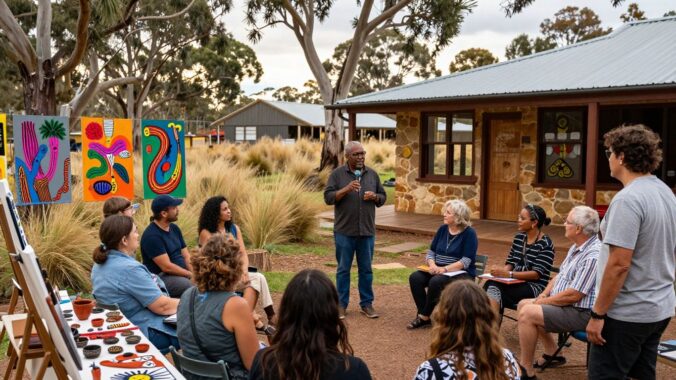
Regional art centres are more than smaller versions of city galleries. They often sit close to the communities, landscapes, histories, and creative networks that shape the work on display. When we visit, we may find an exhibition space alongside studios, classrooms, meeting rooms, a shop, or a venue for local events.
The experience can feel more personal and less formal than a large metropolitan institution. We are often able to spend time with artists, educators, volunteers, and residents who know the area well. That local connection is one reason art centres regional to our interests can become memorable places to return to.
How regional art centres differ from urban galleries
Urban galleries generally have access to large collections, major touring exhibitions, and substantial teams. Regional centres may work with fewer resources, but they can offer a closer relationship with local makers and audiences. Their exhibitions are often shaped by the concerns of the surrounding area rather than by a national exhibition calendar.
We may also notice a different pace. A regional centre can make room for a school display, a community textile group, a visiting artist, or a local history project alongside a formal exhibition. The result is a broader picture of what art means in everyday community life.
The role of art centres in local communities
A regional art centre can be a gathering place as much as a cultural venue. It may give residents a place to learn, exhibit, meet, teach, or simply spend time with other people. For visitors, that makes the centre a useful doorway into the character of a town or district.
These organisations can also help keep creative activity visible between major festivals and touring shows. They create opportunities for conversations that might not happen in a conventional gallery, particularly when local groups help shape the programme. Local knowledge changes the visit, giving us context that a label alone cannot provide.
Common programs, exhibitions, and creative services
Programmes vary widely, so we should avoid assuming that every centre offers the same mix. One may focus on exhibitions and talks, while another puts most of its energy into classes, artist studios, school visits, or community projects. Checking the centre’s own calendar is the best way to understand what is available.
We may come across several familiar forms of activity:
- Temporary exhibitions by local, visiting, or emerging artists.
- Practical classes in drawing, painting, ceramics, photography, textiles, or printmaking.
- Artist talks, opening events, guided tours, and discussions about local culture.
- Creative activities for children, families, schools, or community groups.
- Shops or online catalogues featuring locally made art, books, and gifts.
This range means a centre can be visited more than once for entirely different reasons. We might begin with an exhibition, then return for a class or a conversation with an artist.
Who can benefit from visiting or joining
We do not need specialist knowledge to enjoy a regional art centre. First-time visitors can look, ask questions, and follow their curiosity without knowing every artistic term. Families, older visitors, students, travellers, artists, and people seeking a gentle community activity may all find something that suits them.
Joining a class or membership programme can be especially useful when we want a stronger connection than a single visit provides. It gives us a reason to return and a chance to meet people who share an interest in making or discussing art. Even a short visit can offer a fresh way to understand a place.
Finding art centres regional to your interests
Finding the right centre is less about locating the biggest venue and more about matching a place to our interests, time, and travel plans. We might be looking for Indigenous art, regional history, family activities, contemporary practice, craft, photography, or a quiet gallery visit. A little research helps us choose a centre where the programme feels relevant.
Search results can be a useful starting point, but they do not always show the full picture. We should check the centre’s own website or social pages for current opening hours, exhibition dates, booking requirements, and access information. Programmes can change, especially when they depend on visiting artists or community availability.
Searching by location and travel distance
Start with a practical map search using the town, district, or route we plan to visit. Local councils, tourism organisations, libraries, and community directories may also list galleries and arts organisations that are not prominent in broader search results. If we are travelling through several towns, a simple route plan can reveal useful stops along the way.
Distance is only one consideration. Opening days, parking, public transport, road conditions, and the length of the exhibition should also influence our choice. A centre that is slightly farther away may be a better option if it has a programme we genuinely want to experience.
Exploring exhibitions, classes, and events
Once we have found a few possibilities, we can compare what each centre actually offers during our visit. Look for exhibition descriptions, age guidance, class levels, booking details, event times, and information about whether activities are drop-in or ticketed. This avoids arriving with one expectation and finding a different programme.
It can help to sort our options into a short list before travelling:
- A current exhibition that interests us.
- A public event or artist talk that fits our schedule.
- A class or hands-on activity requiring advance booking.
- A community or cultural programme that needs respectful preparation.
This approach keeps the planning manageable while leaving room for an unplanned discovery. We should still allow time to browse slowly, speak with staff, or visit another local place nearby.
Checking accessibility and visitor amenities
Accessibility information deserves the same attention as exhibition details. We can check whether the entrance, galleries, toilets, seating, and workshop areas suit our needs, and whether assistance is available on request. If information is unclear, contacting the centre before visiting is often the simplest option.
It is also worth checking practical amenities such as parking, public transport, child-friendly facilities, café arrangements, mobile reception, and photography rules. Regional venues may have limited opening hours or shared buildings, so small details can make a real difference to the day. Good planning helps us arrive relaxed rather than rushed.
Comparing nonprofit, public, and independent centres
The organisation’s structure can explain some differences in its programme and funding. A public centre may be supported by a council or cultural body, while a nonprofit may rely on memberships, donations, grants, volunteers, and event income. An independent centre may have a more personal curatorial direction or focus on a particular artistic community.
None of these models is automatically better. We can compare the centre’s purpose, programme, access arrangements, and relationship with local artists instead of judging it by its label. Understanding how a place operates can also show us the most useful way to support it during a visit.
Planning a rewarding visit
A rewarding visit does not need an elaborate itinerary. We mainly need enough information to avoid missing the exhibition, class, or event that brought us there in the first place. A flexible plan gives us structure while preserving the pleasure of wandering and noticing details.
We can also treat the visit as part of a wider regional experience. A centre may sit near a historic main street, a cultural landscape, a market, or other community venues. Taking time to understand the setting can deepen our appreciation of the stories and creative work inside the building.
Choosing the best time to go
The best time depends on what kind of experience we want. A quiet weekday may suit us if we prefer to look closely and ask staff questions, while an opening night or community event can bring energy, conversation, and a chance to meet local makers. Families may find school-holiday activities convenient, although those periods can be busier.
We should check whether the centre closes between exhibitions or has reduced hours on public holidays. If we are travelling a long way, it is sensible to confirm the details shortly before setting out. A quick call or website check can prevent a disappointing detour.
Reviewing current exhibitions and schedules
Before we go, read the exhibition descriptions rather than relying only on a title or image. The description may explain the artists’ connection to the region, the materials used, the cultural context, or the intended audience. It can give us useful questions to carry into the galleries.
A simple visit plan might include the exhibition opening hours, a booked activity, time for conversation, and space to browse the shop or surrounding area. We should not pack the day so tightly that every delay becomes a problem. The most valuable moments are sometimes the ones we did not schedule.
Preparing for workshops and hands-on activities
Workshops may require booking, payment, particular clothing, or materials that are not supplied. We can read the conditions carefully and ask about skill level before committing. Beginners are often welcome, but it is better to know whether an activity is designed as a relaxed introduction or a more focused course.
Arriving a little early gives us time to settle in and understand the instructions. We should follow the facilitator’s guidance, respect shared equipment, and be considerate of different confidence levels in the group. The aim is participation, not producing a perfect object.
Making the most of guided tours and community events
A guided tour can reveal connections we might miss on our own, particularly when the guide has knowledge of the artists, materials, or local history. We can listen for the stories behind the work and ask open questions rather than trying to test our own interpretations. Community events may offer an even wider range of voices.
A useful principle is to enter these occasions with curiosity and patience.
The best cultural visits leave room for listening as well as looking.
That attitude helps us receive information respectfully, especially when a programme is led by local or Indigenous communities. We should follow the centre’s guidance about photography, recording, participation, and discussion.
Discovering local artists and cultural stories
Regional art centres can help us see a place through the eyes of people who live there. Artists may respond to landscape, family history, migration, work, language, memory, or social change. Their work does not have to provide a complete account of a region to make a meaningful contribution to its cultural life.
We should approach local stories with care. A short label may offer an introduction, but it cannot replace the artist’s own words or the knowledge of the communities involved. When a programme provides talks, publications, or community-led interpretation, those resources can help us listen more thoughtfully.
Learning how centres support emerging artists
Many centres provide early-career artists with opportunities to exhibit, teach, meet audiences, or develop professional experience. The exact support may be modest, such as a first solo exhibition, a shared studio, a mentoring relationship, or inclusion in a group show. These opportunities can matter greatly in places where artists are spread across large distances.
We can learn more by reading artist biographies, attending talks, and asking staff about the programme’s purpose. Buying a catalogue, sharing an exhibition, or returning with a friend can help an emerging artist reach a wider audience. Support does not always have to be expensive to be useful.
Exploring regional history through art
Art can make history feel close and particular. A painting may record changes to a town, a textile may carry family knowledge, and a photographic project may show how a landscape has been used or remembered. These works invite us to consider whose stories have been preserved and whose stories may still need space.
We should resist treating every artwork as a simple historical document. Artists interpret, question, rearrange, and sometimes challenge the official version of events. Reading the accompanying material and listening to local perspectives helps us understand the difference between evidence, memory, and creative expression.
Understanding Indigenous and community-led programming
When a programme is led by First Nations artists or communities, we should begin by respecting the centre’s guidance about cultural material, permissions, photography, and participation. Indigenous art is not one single style or story; it is connected to distinct peoples, places, languages, practices, and lived experiences. The centre’s local context matters.
We can take time to read the information provided, attend a talk where appropriate, and avoid making assumptions about meanings that have not been shared. Where the programme identifies community leadership, that leadership should guide how we engage. Respectful attention is part of the experience, not an extra step added afterwards.
Buying work directly from local creators
A centre shop or exhibition sale can provide a direct way to support artists and makers. Before buying, we can ask who created the work, where it was made, what materials were used, and whether the artist receives the stated proceeds. Clear information allows us to purchase with confidence and appreciation.
We should also think about care, transport, and authenticity where relevant. If a work has cultural restrictions or specific handling instructions, the seller should be able to explain them. A considered purchase becomes more meaningful when we understand the story and responsibilities connected with it.
Supporting regional art centres
Regional art centres often depend on a mixture of earned income, public support, philanthropy, memberships, volunteers, and community goodwill. Their work can look simple from the outside, but exhibitions and programmes require planning, buildings, equipment, administration, and relationships. Our support helps sustain the conditions in which local creativity can continue.
We do not need to make a large commitment to contribute. Attending a programme, paying an entry fee where one applies, joining a mailing list, or telling someone about a good exhibition can all help. The most useful action depends on what the centre says it needs.
Attending events and becoming a member
Events bring audiences into the building and create paid opportunities for artists, facilitators, technicians, and other workers. We can attend an opening, talk, class, screening, market, or community gathering when the subject and timing suit us. If we enjoy returning, membership may offer practical benefits while providing steadier support.
Before joining, we should check what the membership includes and how long it lasts. Some centres offer invitations, discounts, or early booking, while others focus mainly on supporting the programme. Either way, membership can signal that the centre has a continuing place in our lives.
Donating, volunteering, or sponsoring programs
A donation can be directed towards general operations or a particular programme, depending on the centre’s arrangements. We can ask how contributions are used rather than assuming every organisation has the same priorities. Even small recurring gifts may be helpful if they fit comfortably within our circumstances.
Volunteering is another option, but it should be organised around the centre’s real needs. Possible tasks include welcoming visitors, helping with events, administration, installation, gardening, or community outreach. Sponsorship should be approached with the same care: we can look for clear information about recognition, purpose, and the people who benefit.
Purchasing artwork and gifts
Buying from the centre shop supports a chain of local creative work, although we should always check the terms of sale and the artist’s share. A small print, card, book, piece of craft, or locally made gift may be a practical choice when an original artwork is beyond our budget. It also gives us a way to keep the visit present in daily life.
We should buy because we genuinely value the item, not because we feel pressured. Asking about care instructions, packaging, and the maker’s background can make the purchase more considered. When we tell the recipient where the gift came from, we extend the centre’s reach naturally.
Promoting centres through local networks and social media
A thoughtful recommendation can bring new visitors to a regional centre. We can share a current exhibition, event, or class with friends, local groups, accommodation providers, schools, and community networks. If we post online, we should follow the centre’s photography rules and use the information it provides.
Specific recommendations are more useful than vague praise. Mentioning what we saw, who might enjoy it, and when it is available gives people a reason to visit. We should also credit artists and the centre accurately rather than presenting cultural material without context.
Building a lasting connection with the arts
One visit can introduce us to a region’s artists, but repeated visits reveal how a creative community develops. Exhibitions change, artists return with new work, and familiar spaces can feel different during a class or public event. Over time, we begin to recognise the people and questions that shape the centre.
A lasting connection does not require us to become experts or regular donors. It may simply mean keeping an eye on the programme, returning when we travel nearby, or making room for a creative activity in our routine. The relationship grows through attention and consistency.
Returning for seasonal exhibitions
Seasonal exhibitions give us a reason to revisit a centre and see different parts of its programme. A winter group show, a spring community display, or an annual cultural event may have a different mood and audience from a formal gallery exhibition. We can compare how the centre responds to changing themes, materials, and local interests.
Returning also lets us notice details we missed the first time. We may recognise an artist, understand a local reference, or feel more confident asking questions. A place becomes richer when we give it more than one chance to speak.
Joining classes and creative communities
Classes create a practical connection because we learn alongside other people rather than only looking at finished work. We might discover a new material, revisit an old interest, or find that the social part of making matters as much as the technique. Skill level is only one reason to join.
We can choose a short workshop if our schedule is uncertain, or a longer course if we want a steady creative habit. Being respectful of the tutor, the group, and the cultural setting is essential, particularly when learning a practice connected with a particular community or tradition.
Following artist talks and educational programs
Artist talks and educational programmes can add depth to an exhibition without telling us exactly what to think. Hearing an artist describe materials, process, place, or intention may change the way we look at the work. We can also learn from educators who connect the programme with schools, families, history, and community life.
If we cannot attend in person, the centre may share recordings, interviews, newsletters, or reading material. We can follow at a pace that suits us and return to the gallery with new questions. Learning continues beyond the walls of the exhibition.
Sharing regional art experiences with others
Sharing a visit can be as simple as inviting a friend, telling a local host what we enjoyed, or recommending a centre to someone planning a trip. We can describe the experience honestly, including whether advance booking or extra travel time is needed. That kind of practical detail helps others make respectful plans.
We can also share what we learned about the artists and community, while avoiding claims that go beyond the information provided. A regional art centre is not just a stop on a route; it is part of a living cultural network. When we visit thoughtfully and encourage others to do the same, that network has a better chance to remain visible and connected.